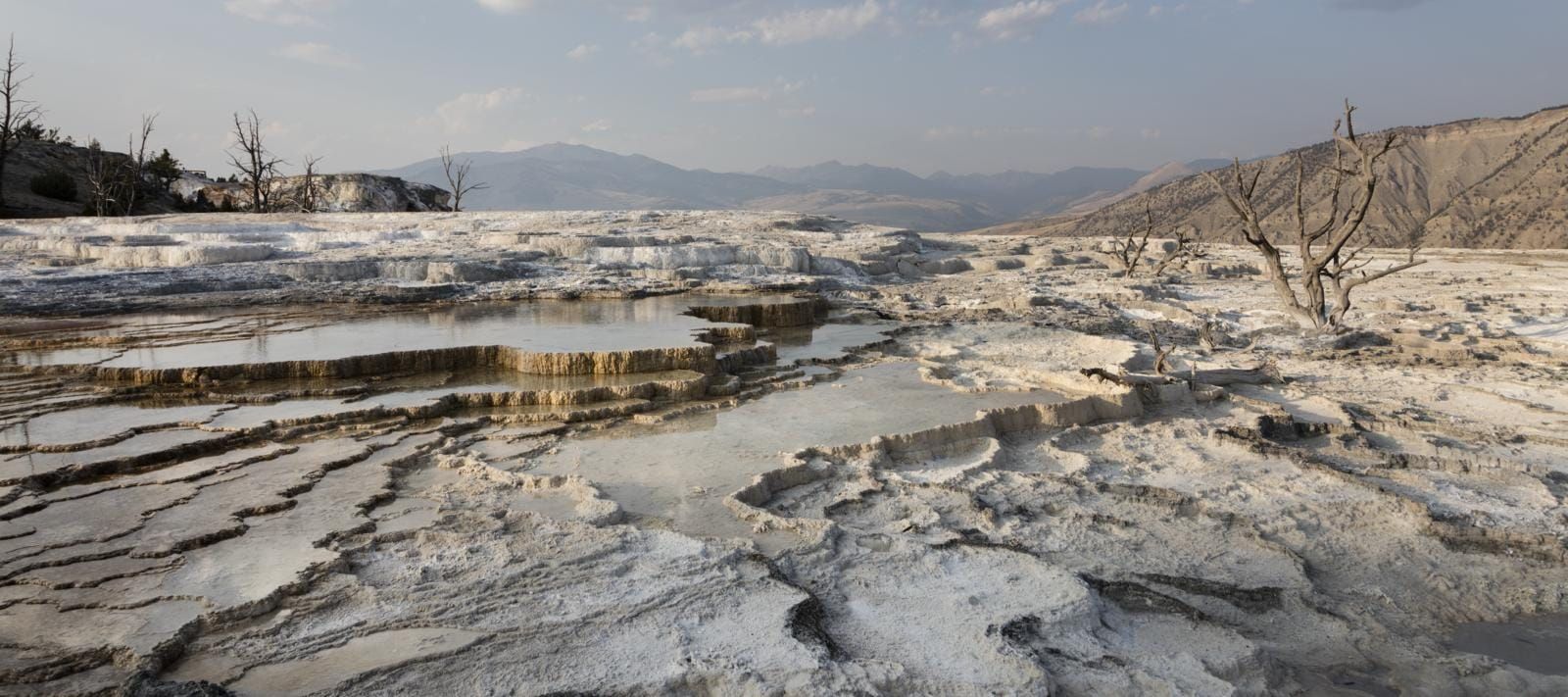
On April 9, 2026 the U.S. Attorney's Office for the District of Wyoming announced that a fifty-year-old man from Frisco, Texas had been sentenced to five days in jail for walking off the boardwalk at Mammoth Hot Springs. According to the announcement, he left the boardwalk and walked directly onto Canary Spring, Mound Terrace, Palette Hot Spring and Jupiter Terrace, leaving footprints in the travertine. He pleaded guilty. Magistrate Judge Stephanie Hambrick imposed the sentence, and the prosecutor was the same assistant U.S. attorney who has handled most of the thermal cases in the last three years.
The U.S. Attorney's statement is worth quoting because it tells you how the office thinks about these cases: "Yellowstone's thermal areas are among the most dangerous natural features in the world. Mr. Bedient's disregard for the law could have cost him his life. Prosecuting crimes like this deters others from similar conduct." Deterrence is the word. The sentence is not about the footprints. It is about the next person reading the story.
The rule has one sentence
The regulation is 36 CFR § 7.13(j), Yellowstone's own special rule: "Foot travel in all thermal areas and within the Yellowstone Canyon between the Upper Falls and Inspiration Point must be confined to boardwalks or trails that are maintained for such travel and are marked by official signs." A thermal area, under the park's compendium, is "any area where surface manifestations of hot springs, geysers, mud springs, fumaroles, or warm ground are present." Nothing in the sentence says knowing or willful. You do not have to have seen a sign. You have to have been off the boardwalk in a thermal area.
On the District of Wyoming's collateral schedule, the list of offenses you can pay by mail, § 7.13(j) has no dollar amount. It is marked mandatory appearance. That single line is what separates a thermal citation from almost every other park ticket. A speeding notice can be paid and forgotten. A thermal notice cannot be paid at all. It comes with a date in front of the magistrate judge, and the only questions are what you plead and what the sentence is.
What the sentences have looked like
The Mammoth case is not an outlier. It sits in the middle of a run of announced sentences from the same courtroom. A Seattle woman who walked about ten feet onto the cone of Old Faithful received seven days. A Georgia man who drove off the road into a thermal area and walked around received seven days, five years of probation with a ban from the park, and about a thousand dollars in fines and costs. A Washington man who crossed the fence at Steamboat Geyser received seven days, a two-year ban, and a $1,500 fine. A Colorado man who took his family into the protected area at Canary Spring received seven days, five years of probation with a ban, and a $3,000 fine. The announced sentences that avoided custody involved defendants who did not go far, did not damage anything, and came to court ready to accept responsibility and pay: a well-known actor who stood on a feature at Mammoth in 2023 paid a $500 fine and a $1,000 contribution to the park's geological fund and went home the same day.
So the range is real, and it runs from a fine to a week in jail with a multi-year ban. Where a case lands depends on facts the ranger wrote down and facts a lawyer develops afterward: how far off the boardwalk, whether a feature was touched or damaged, whether there was a fence, whether alcohol was involved, whether there is video, and what the video shows you doing when the ranger arrived.
Why the park is right about the danger, and why that matters to your case
The government's position is not posturing. The ground around a hot spring can be a thin crust over water well above boiling. The U.S. Geological Survey counts twenty-two scalding deaths in the park since 1872 and hundreds of injuries, more than bears and bison together. The Park Service's own safety page says burns from thermal features "are a common cause of serious injury and death." A judge who has read those numbers is not going to be moved by the argument that it was only a few steps. The argument that works is different: what you did, what you did not do, and what you have done since.
Three things that make a thermal case worse
The first is the phone. Nearly every announced case had video, sometimes the defendant's own, sometimes another visitor's, and the caption on a post is treated as an admission that you knew where you were. Deleting a post after a ranger has asked about it is its own problem, because knowingly destroying a record to obstruct a federal matter is a felony under 18 U.S.C. § 1519. Leave everything where it is and give it to your lawyer.
The second is a second count. Rangers frequently pair § 7.13(j) with a closure violation under § 1.5(f), or with destroying a mineral resource under § 2.1(a)(1)(iv) when a feature was marked. The Colorado case at Canary Spring was charged both ways, and the $3,000 fine reflects it.
The third is treating the notice like a ticket. Because there is no collateral, some people assume the case will go away if they ignore the mail. It does not. The Central Violations Bureau sends a Notice to Appear four to eight weeks after the citation, and a person who does not appear on a mandatory-appearance offense has a warrant, not a fine.
What a good outcome looks like
In a case where nobody was hurt and nothing was damaged, the outcome I work toward is a resolution without custody: a fine, a contribution to the park's geological fund, and a probation term short enough to be lived with, or no probation at all. Whether that is available depends on the facts and on the presentation, and the presentation starts the week you get home, not the morning of the hearing. The federal rules also allow a defendant to consent in writing to appearing by video, so a resolution that does not involve a flight to Bozeman and a drive to Mammoth is usually possible.
This article is general information about federal park regulations, not advice about your case.